Pendulum Exercise
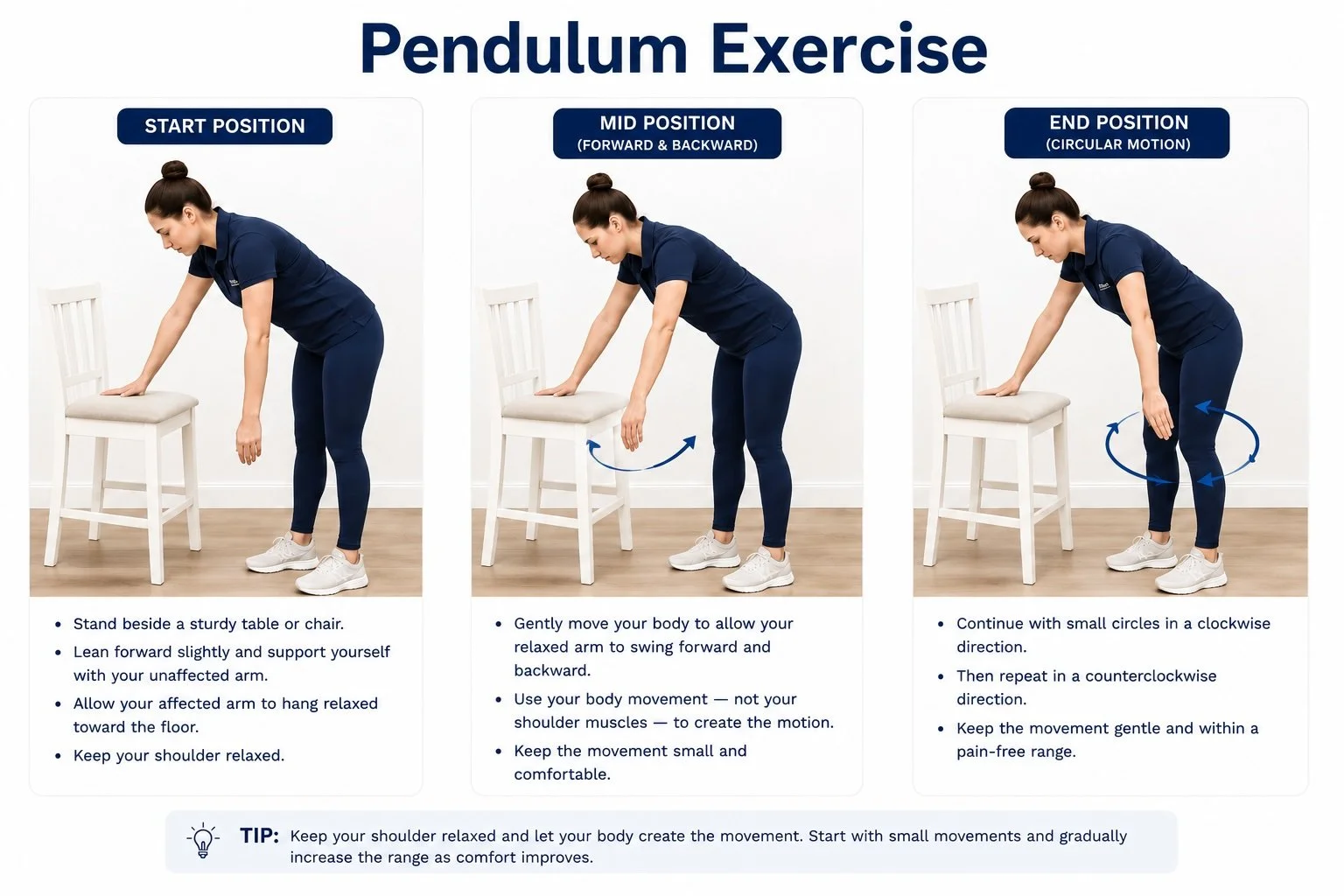
Improve Shoulder Mobility & Support Early Shoulder Rehabilitation
The Pendulum Exercise is a gentle shoulder mobility exercise that may be included as part of a home-care plan to support shoulder movement and reduce stiffness. It is commonly used during the early stages of shoulder rehabilitation for concerns such as frozen shoulder, rotator cuff injuries, and after shoulder surgery when recommended by your healthcare provider.
What Does This Exercise Help?
This exercise may be included as part of an individualized home-care plan for concerns such as:
Frozen Shoulder (Adhesive Capsulitis)
Shoulder Pain
Rotator Cuff Injuries
Shoulder Impingement
Shoulder Stiffness
Post-Surgical Shoulder Rehabilitation (when appropriate)
Limited Shoulder Mobility
Equipment Needed
A sturdy table, countertop, or chair for support
Starting Position
Stand beside a sturdy table or chair.
Lean forward slightly while supporting yourself with your unaffected arm.
Allow your affected arm to hang relaxed toward the floor.
Keep your shoulder relaxed throughout the exercise.
Step-by-Step Instructions
Step 1
Gently move your body to allow your relaxed arm to swing forward and backward.
Step 2
Use your body movement — not your shoulder muscles — to create the motion.
Keep the movement small and comfortable.
Step 3
After completing the forward and backward swings, gently repeat the movement side to side.
Next, perform small clockwise circles, followed by small counterclockwise circles.
Keep all movements slow, relaxed, and within a comfortable range.
Recommended Repetitions
10–15 repetitions in each direction
2–3 sets
Perform once or twice daily, or as recommended by your healthcare provider.
Tips
Keep your shoulder relaxed.
Let your body create the movement.
Start with small circles and gradually increase the size as comfort improves.
Move within a comfortable range.
Common Mistakes
Lifting the shoulder
Actively swinging the arm using shoulder muscles
Making large circles too soon
Holding your breath
Stop the Exercise If
Stop the exercise and consult your healthcare provider if you experience:
Sharp or severe pain
Numbness or tingling
Pain that continues to worsen during or after the exercise
Related Conditions & Concerns
This exercise may be included as part of an individualized home-care plan for concerns such as:
Frozen Shoulder
Shoulder Pain
Rotator Cuff Injuries
Shoulder Impingement
Shoulder Stiffness
Related Services
Need More Help?
If shoulder pain or stiffness is affecting your daily activities, our team at Pelham Massage Therapy & Osteopathy Clinic can assess your individual needs and discuss whether Massage Therapy or Osteopathy may be appropriate as part of your care.
Disclaimer
This exercise is provided for educational purposes only and may not be appropriate for everyone. Stop the exercise if it causes increasing pain, numbness, tingling, dizziness, or other concerning symptoms. If you are unsure whether this exercise is right for you, consult your healthcare provider or book an appointment.
Pelham Massage Therapy & Osteopathy Clinic Inc.