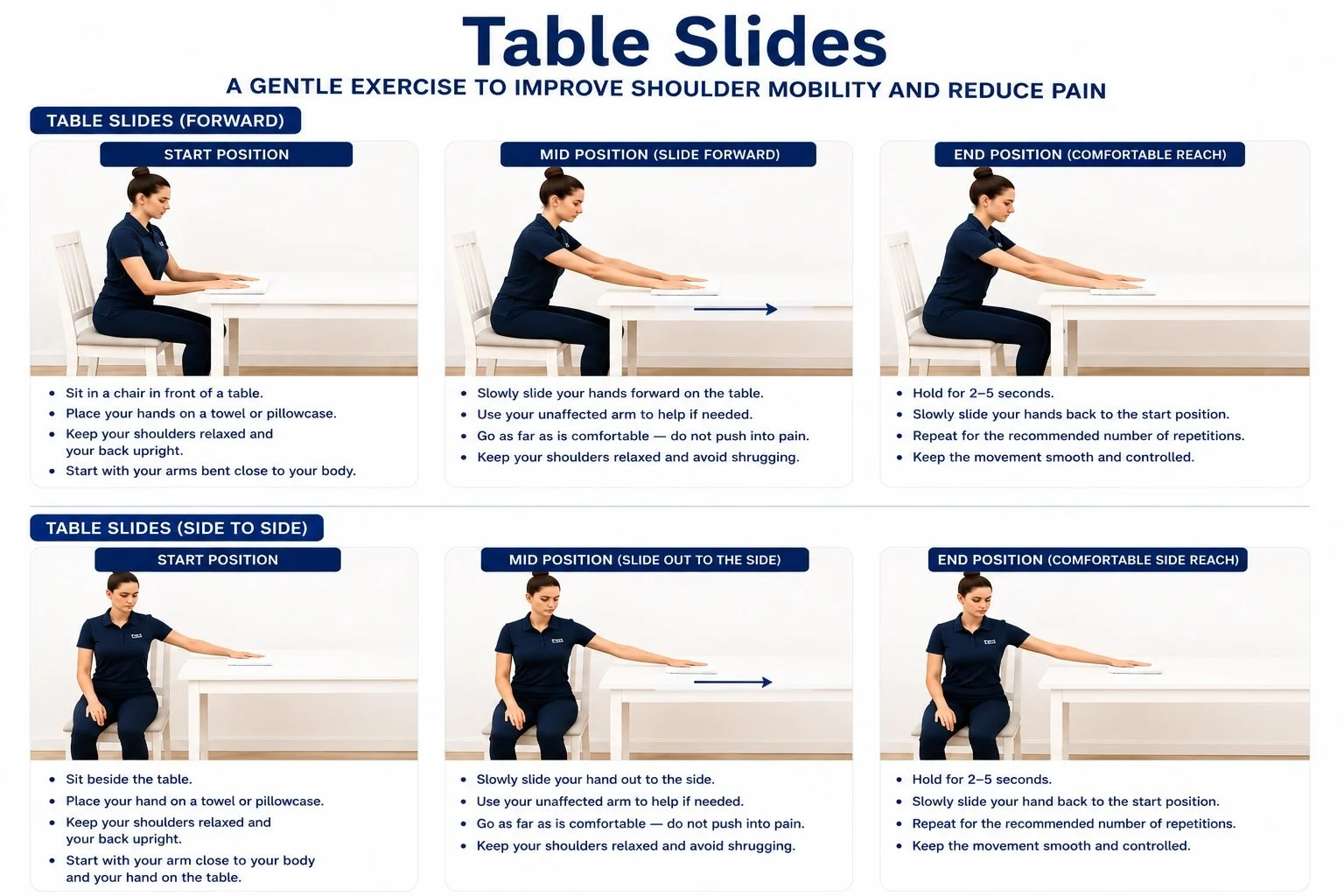
Table Slides are a gentle shoulder mobility exercise designed to improve range of motion while minimizing strain on the shoulder. They may be included as part of a home-care plan for concerns such as frozen shoulder, rotator cuff injuries, shoulder impingement, and general shoulder stiffness.
What Does This Exercise Help?
This exercise may be included as part of an individualized home-care plan for concerns such as:
Frozen Shoulder (Adhesive Capsulitis)
Shoulder Stiffness
Rotator Cuff Injuries
Shoulder Impingement
Limited Overhead Movement
Shoulder Mobility During Rehabilitation
Equipment Needed
A sturdy table
A chair
A towel or pillowcase to help your hand slide smoothly
Table Slides – Forward
Starting Position
Sit facing a table.
Place both hands on a towel or pillowcase.
Sit upright with relaxed shoulders.
Keep your elbows comfortably bent.
Step 1
Slowly slide your hands forward across the table while allowing your body to lean forward naturally.
Step 2
Slide only as far as you comfortably can without increasing your pain.
Hold the stretch for 2–5 seconds.
Step 3
Slowly return to the starting position using a smooth, controlled movement.
Repeat.
Table Slides – Side-to-Side
Starting Position
Sit beside a table.
Rest your affected arm on a towel or pillowcase.
Keep your shoulders relaxed and your back upright.
Step 1
Slowly slide your arm outward to the side across the table.
Step 2
Move only within a comfortable range.
Pause briefly at the end of the movement.
Step 3
Slowly return your arm to the starting position.
Repeat.
Recommended Repetitions
10 repetitions
2–3 sets
Perform once or twice daily, or as recommended by your healthcare provider.
Tips
Move slowly and with control.
Keep your shoulders relaxed.
Stay within a comfortable range of motion.
Breathe normally throughout the exercise.
Common Mistakes
Shrugging your shoulders.
Leaning excessively.
Pushing into pain.
Moving too quickly.
Stop the Exercise If
Stop the exercise and consult your healthcare provider if you experience:
Sharp or severe pain
Numbness or tingling
Pain that continues to increase after completing the exercise
Related Conditions & Concerns
This exercise may be included as part of an individualized home-care plan for concerns such as:
Frozen Shoulder
Shoulder Pain
Rotator Cuff Injuries
Shoulder Impingement
Shoulder Stiffness
Related Services
Need More Help?
If shoulder pain or stiffness is affecting your daily activities, our team at Pelham Massage Therapy & Osteopathy Clinic can assess your individual needs and discuss whether Massage Therapy or Osteopathy may be appropriate as part of your care.
Disclaimer
This exercise is provided for educational purposes only and may not be appropriate for everyone. Stop the exercise if it causes increasing pain, numbness, tingling, dizziness, or any other concerning symptoms. If you are unsure whether this exercise is appropriate for you, consult your healthcare provider or book an assessment with
Pelham Massage Therapy & Osteopathy Clinic.