Isometric External Rotation
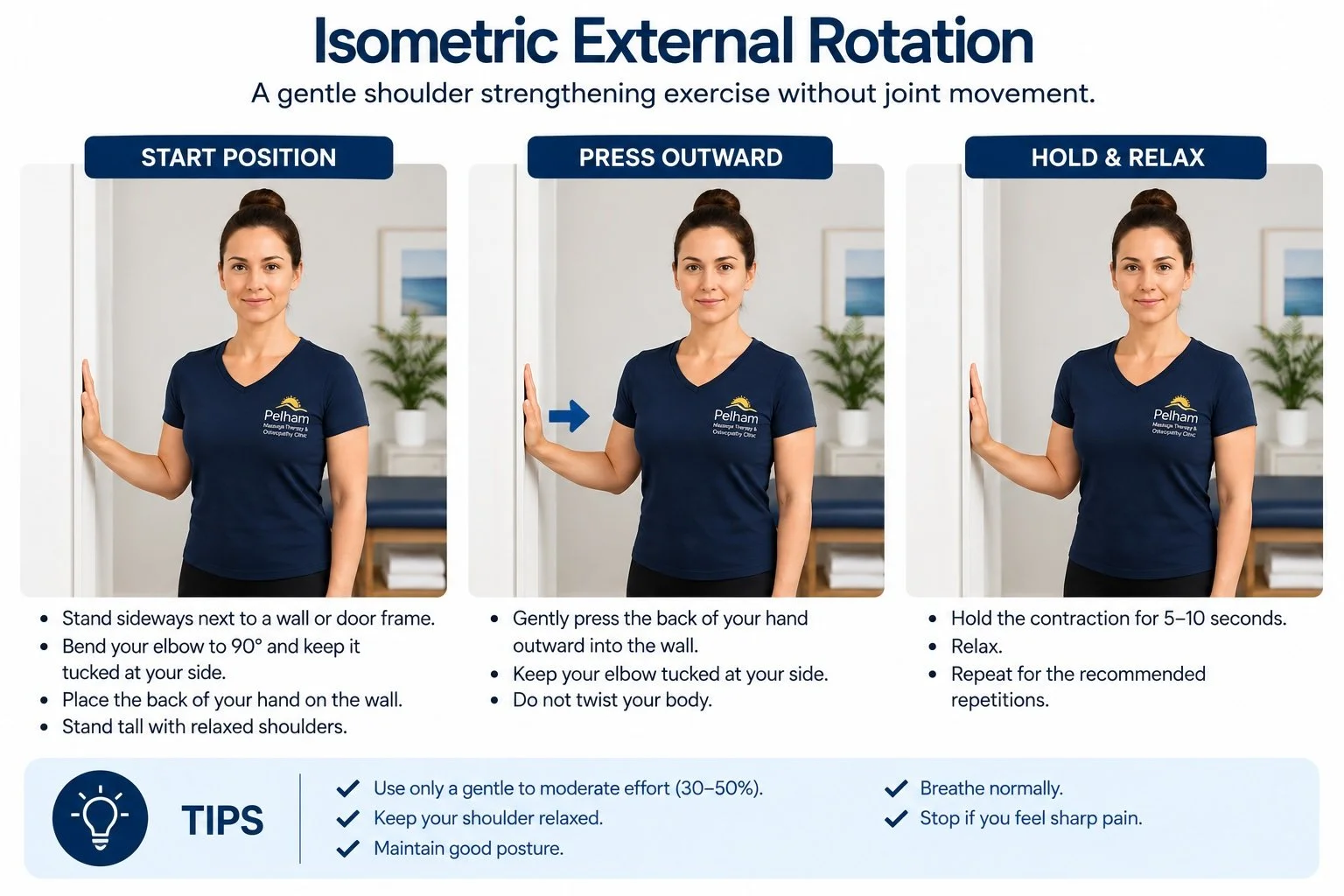
Isometric External Rotation
The Isometric External Rotation exercise is a gentle strengthening exercise used to activate the muscles that support the shoulder without requiring visible movement at the joint. It may be included as part of an exercise or home-care program when controlled strengthening is appropriate.
What May This Exercise Support?
This exercise may be used as part of an exercise or home-care program for:
Rotator cuff weakness
Shoulder weakness
Shoulder instability
Limited shoulder movement
Reduced shoulder control
Early-stage strengthening when appropriate
Potential Benefits
Supports rotator cuff strength
Supports shoulder stability
Helps build strength without moving the joint
Encourages controlled muscle activation
May help prepare for more advanced strengthening exercises
Equipment Needed
A wall or sturdy door frame
Starting Position
Stand sideways beside a wall or door frame.
Bend your elbow to 90 degrees and keep it tucked against your side.
Place the back of your hand against the wall.
Stand tall with relaxed shoulders.
Step 1
Gently press the back of your hand outward into the wall as if trying to rotate your arm away from your body.
Step 2
Keep your elbow tucked firmly against your side and avoid twisting your body.
Step 3
Hold the contraction for 5–10 seconds, then relax.
Repeat for the recommended number of repetitions before switching arms if needed.
Recommended Repetitions
Hold for 5–10 seconds
Repeat 8–10 times
Perform 1–2 sets
Complete once or twice daily, or as recommended by your healthcare provider
Tips
Use only a gentle to moderate effort.
Keep your shoulder relaxed.
Maintain good posture throughout the exercise.
Breathe normally.
Stop if the exercise causes sharp pain.
Common Mistakes
Letting the elbow move away from your side
Twisting the trunk
Pressing too hard
Holding your breath
Shrugging the shoulder
Stop the Exercise If
Stop and consult your healthcare provider if you experience:
Sharp or worsening shoulder pain
Numbness or tingling
A feeling of shoulder instability
Increased discomfort that persists after the exercise
Related Conditions & Concerns
This exercise may be included as part of an individualized home-care plan for concerns such as:
Rotator cuff weakness
Shoulder weakness
Shoulder instability
Limited shoulder movement
Reduced shoulder control
Related Services
Need More Help?
If shoulder discomfort, weakness, or limited movement is affecting your daily activities, a healthcare provider can assess your individual needs and determine whether exercises such as Isometric External Rotation may be appropriate as part of your care plan.
Pelham Massage Therapy & Osteopathy Clinic Inc.
Disclaimer
This exercise is intended for general educational purposes only and should not replace professional medical advice, diagnosis, or treatment. Stop the exercise if you experience significant pain or worsening symptoms, and consult your healthcare provider if you are unsure whether this exercise is appropriate for you.