Trigger Finger: Causes, Symptoms & How Treatment May Help
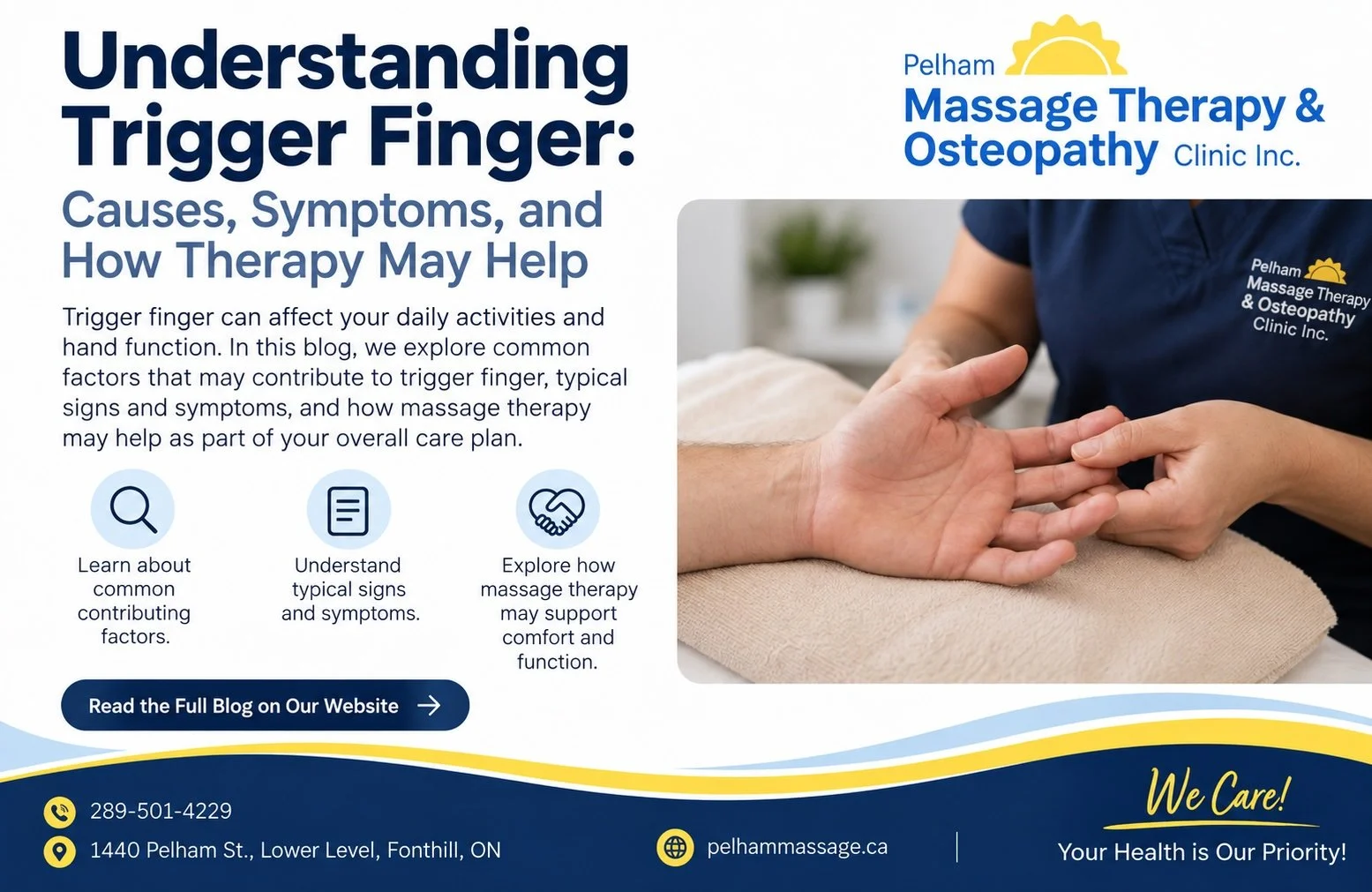
Trigger finger may seem like a small problem, but when a finger becomes painful, stiff, or difficult to move, it can have a surprisingly big impact on everyday activities.
Gripping a coffee mug, opening a jar, typing, gardening, working with tools, or simply making a fist can become uncomfortable.
Trigger finger, also known as stenosing tenosynovitis, affects the tendons that help bend the fingers and thumb. It can cause pain, stiffness, clicking, catching, or even temporary locking of the affected finger.
At Pelham Massage Therapy & Osteopathy Clinic, we work with clients experiencing a variety of hand, wrist, and upper-extremity concerns. Treatment may help address surrounding muscle tension, mobility restrictions, and other factors that may be contributing to discomfort.
What Is Trigger Finger?
The tendons that bend your fingers travel through small tunnels called tendon sheaths.
With trigger finger, the tendon and surrounding sheath can become irritated or thickened. This can make it more difficult for the tendon to glide smoothly as the finger bends and straightens.
As the tendon moves through the narrowed area, you may experience a catching or popping sensation.
In some cases, the finger may temporarily become stuck in a bent position before suddenly straightening.
Which Fingers Are Most Commonly Affected?
Trigger finger can occur in any finger or thumb.
The ring finger and thumb are commonly affected, although the middle finger, index finger, and little finger can also develop symptoms.
More than one finger may be affected at the same time, and symptoms can occur in either hand.
Common Symptoms of Trigger Finger
Symptoms can range from mild stiffness to significant difficulty moving the finger.
You may notice:
Pain or tenderness near the base of the affected finger
Finger stiffness, particularly after periods of inactivity
Clicking or popping when bending or straightening the finger
A catching sensation during movement
Difficulty fully bending or straightening the finger
A small tender area or bump near the base of the finger
The finger temporarily locking in a bent position
Discomfort when gripping or holding objects
Symptoms may be more noticeable first thing in the morning or after the hand has been resting.
What Causes Trigger Finger?
Trigger finger develops when the flexor tendon and the area through which it travels become irritated or narrowed.
Repetitive gripping and frequent hand use may contribute to irritation in some people, although trigger finger does not always have one obvious cause.
Certain health conditions can also be associated with an increased likelihood of developing trigger finger.
Because finger pain and locking can have different causes, persistent or worsening symptoms should be properly assessed.
How Can Massage Therapy Help?
Massage Therapy does not remove the mechanical narrowing associated with trigger finger, but treatment may be helpful for addressing some of the surrounding soft-tissue tension and discomfort.
Depending on your individual assessment, Massage Therapy may focus on the muscles and soft tissues of the:
Hand
Wrist
Forearm
Elbow
Upper arm
Treatment may help:
Manage pain and stiffness
Reduce surrounding muscle tension
Support comfortable hand and wrist movement
Improve mobility in surrounding tissues
Address tension related to repetitive hand use
Your Registered Massage Therapist will adjust treatment according to your symptoms, comfort level, and individual needs.
Can Osteopathy Help?
Osteopathic treatment takes a broader look at movement and function throughout the body.
When appropriate, an osteopathic assessment may consider the mobility of the hand and wrist as well as other areas of the upper extremity that may be influencing movement.
Treatment may focus on improving mobility and reducing restrictions in surrounding tissues.
The approach will depend on your individual assessment and presentation.
What Can I Do at Home?
Reducing activities that repeatedly aggravate the finger may help settle symptoms.
Depending on the severity and cause of your symptoms, gentle hand and finger mobility may also be appropriate.
Avoid repeatedly forcing a finger through painful catching or locking.
We will also be adding Trigger Finger exercises to our Exercise Library to provide general movement ideas and education for the hand and fingers.
When Should Trigger Finger Be Assessed?
Consider seeking assessment if:
Your finger repeatedly catches or locks
Pain is interfering with everyday activities
You cannot fully bend or straighten the finger
Symptoms continue to worsen
You have significant swelling or redness
You are unsure whether your symptoms are actually trigger finger
A healthcare provider can help determine the cause of your symptoms and whether additional medical treatment is appropriate.
Frequently Asked Questions
Can trigger finger go away on its own?
Mild symptoms may improve with activity modification and time, but persistent or worsening trigger finger may require further assessment and treatment.
Why is trigger finger worse in the morning?
Stiffness and catching can be more noticeable after the hand has been inactive for several hours, which is why some people experience more difficulty first thing in the morning.
Can more than one finger have trigger finger?
Yes. Trigger finger can affect more than one digit and can occur in either hand.
Is the ring finger commonly affected?
Yes. The ring finger is one of the digits commonly affected by trigger finger, along with the thumb.
Should I exercise a trigger finger?
Gentle movement may be appropriate for some people, but exercises should not involve repeatedly forcing the finger through painful catching or locking. The appropriate approach depends on the severity of your symptoms and your individual situation.
Related Services
Massage Therapy
Massage Therapy may help address pain, stiffness, muscle tension, and mobility restrictions involving the hand, wrist, and forearm.
Osteopathy
Osteopathy may help address mobility and restrictions throughout the hand, wrist, and upper extremity based on an individual assessment.
Need More Help?
If finger or hand discomfort is making everyday activities more difficult, our team is here to help.
At Pelham Massage Therapy & Osteopathy Clinic, treatment is individualized based on your symptoms, goals, and assessment.
We Care! Your Health is Our Priority!
Proudly serving Fonthill, Pelham, Welland, and the Niagara Region.
Yes, exactly! If your blog content and footer links are already in place, you don't need to re-do the whole bottom section.
Just paste this brief Tailored to Your Goals block right above your existing "Connect With Us" footer:
Tailored to Your Goals
If finger or hand discomfort is making everyday activities more difficult, our team is here to help. Treatment at Pelham Massage Therapy & Osteopathy Clinic is individualized based on your symptoms, goals, and clinical assessment.
Connect With Us
🌐 Website
📞 Call Us: 289-501-4229
📸 Follow Us on Instagram
This information is intended for general educational purposes and is not a substitute for medical diagnosis or treatment. If you have significant pain, swelling, redness, injury, loss of movement, or persistent locking of the finger, consult an appropriate healthcare professional.
Published by Pelham Massage Therapy & Osteopathy Clinic Inc.