Whole-Body Osteopathy: Understanding Movement and Compensation
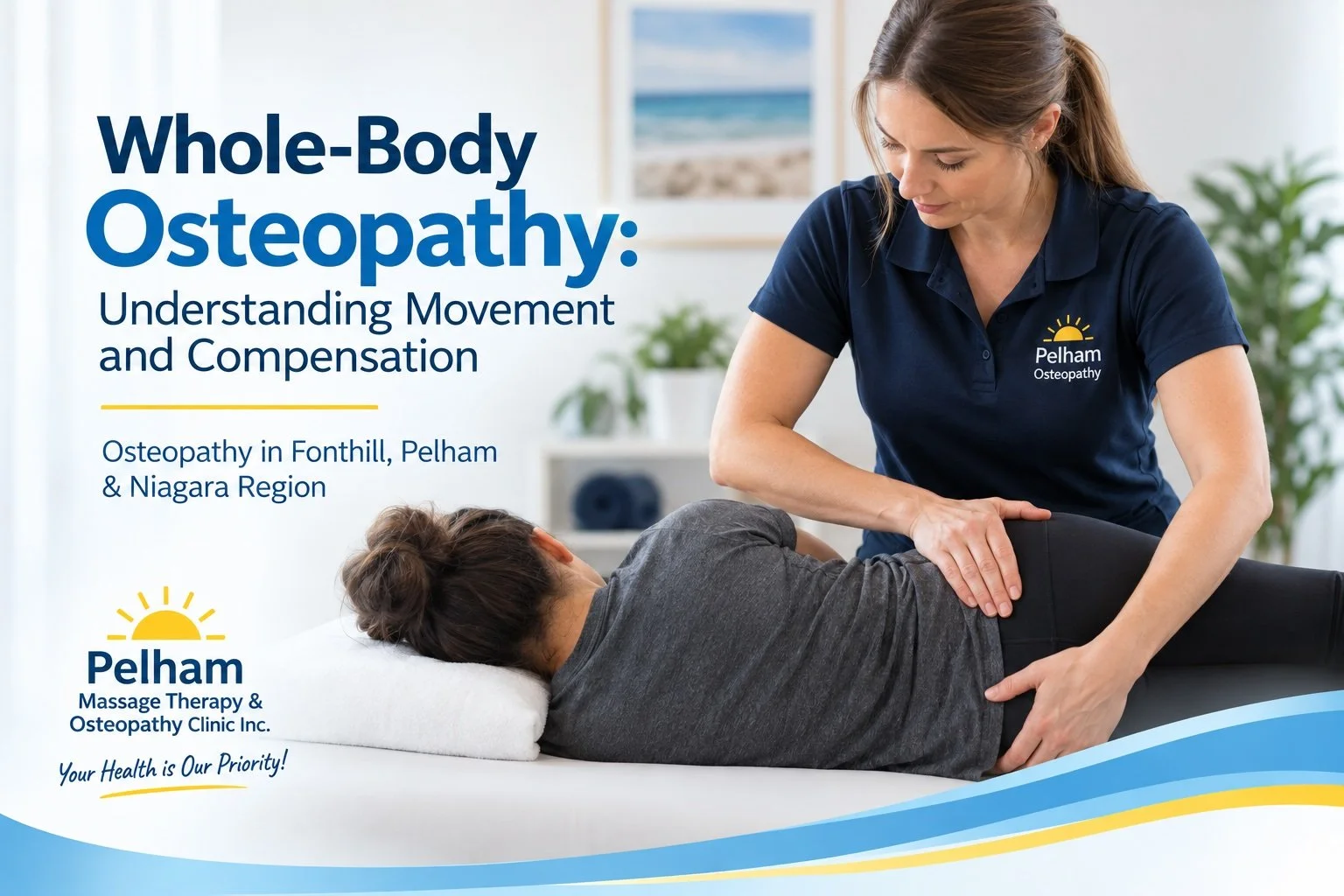
Whole-Body Osteopathic Assessment in Fonthill, Pelham & Niagara Region
The body works as an interconnected system. When one area is stiff, uncomfortable, or moving differently, other areas may adjust how they move in response.
At Pelham Massage Therapy & Osteopathy Clinic in Fonthill, manual osteopathy uses hands-on assessment and treatment to look at mobility, movement, joints, muscles, fascia, posture, and related areas throughout the body.
Our clinic serves clients from Fonthill, Pelham, Welland, Thorold, St. Catharines, Niagara Falls, Niagara-on-the-Lake, and surrounding Niagara Region communities.
What Does “Balance” Mean in Osteopathy?
In this context, “balance” does not refer to a specific medical diagnosis.
It refers more generally to how different areas of the body work together during movement, posture, standing, walking, and everyday activity.
An osteopathic assessment may consider:
Joint mobility
Muscle tension
Fascia and other soft tissues
Posture
Walking patterns
Movement between different regions of the body
Previous injuries
Areas of compensation
The practitioner uses this information to understand how different areas may be related.
How Osteopathy Looks at the Whole Body
Manual osteopathy does not always focus only on the area where symptoms are felt.
For example, an assessment may consider:
Hip mobility when someone has lower-back concerns
Ankle movement when someone has knee concerns
Thoracic and shoulder movement when someone has neck tension
Pelvic movement when someone notices changes in gait
This whole-body approach helps the practitioner decide which areas may be relevant to the individual assessment.
Mobility and Movement
Restricted or uncomfortable movement in one area may influence how another area moves.
An osteopathic practitioner may assess:
Range of motion
Joint mobility
Movement symmetry
Functional movement
Walking patterns
Posture
Treatment techniques are selected based on the assessment findings and the individual’s comfort.
Muscle and Soft-Tissue Tension
Muscles may become tense or guarded when a person changes how they move because of discomfort, previous injury, repetitive activity, or prolonged positioning.
Manual osteopathic treatment may include techniques directed toward muscles, fascia, joints, and other soft tissues.
Posture and Movement Patterns
Posture is influenced by many factors, including:
Work demands
Sitting habits
Physical activity
Previous injuries
Mobility
Strength
Individual anatomy
An osteopathic assessment may consider posture as one part of the overall movement picture rather than treating posture as a single cause of symptoms.
Compensation Patterns
When one area is uncomfortable or restricted, people may change the way they stand, walk, or move.
For example:
A sore ankle may change walking
Hip stiffness may affect lower-limb movement
Shoulder discomfort may change how the upper body moves
Lower-back discomfort may affect sitting or standing posture
These patterns may be considered during an osteopathic assessment.
What to Expect During an Osteopathy Appointment
Your appointment may include:
A health history
Discussion of your symptoms and concerns
Review of previous injuries
Postural assessment
Range-of-motion assessment
Gait or movement observation
Hands-on assessment
Manual osteopathic treatment
Treatment is individualized based on the assessment, health history, and client comfort.
When Should Symptoms Be Medically Assessed?
Manual osteopathy is not a substitute for medical assessment when symptoms may indicate a more serious condition.
Seek appropriate medical care for symptoms such as:
Sudden or severe pain
Significant weakness
New numbness
Loss of bladder or bowel control
Significant trauma
Fever with severe pain
Unexplained weight loss
Symptoms that are rapidly worsening
Osteopathy in Fonthill, Pelham & Niagara Region
Pelham Massage Therapy & Osteopathy Clinic provides manual osteopathy in Fonthill for clients from:
Pelham
Welland
Thorold
St. Catharines
Niagara Falls
Niagara-on-the-Lake
Surrounding Niagara Region communities
If you are experiencing changes in mobility, stiffness, or movement and would like a whole-body assessment, you can book an osteopathy appointment at our Fonthill clinic.
Pelham Massage Therapy & Osteopathy Clinic
1440 Pelham Street, Fonthill, Ontario
pelhammassage.caRelated Services
Connect With Us
Osteopathy focuses on helping the body move, adapt, and function more efficiently as a whole system.
🌐 Website
📞 Call Us: 289-501-4229
We Care! Your Health is Our Priority!
Published by Pelham Massage Therapy & Osteopathy Clinic Inc.