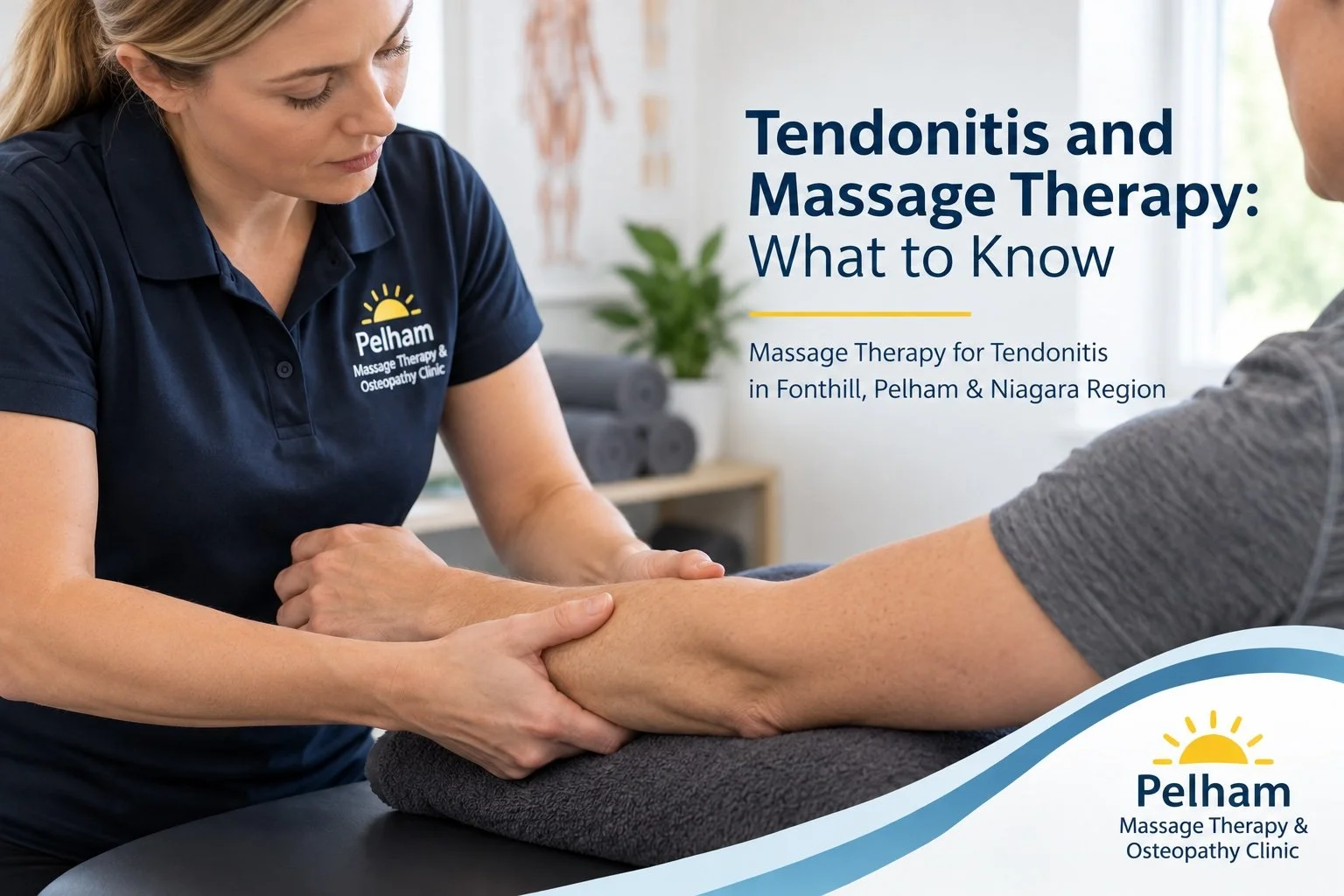
Massage Therapy for Tendonitis in Fonthill, Pelham & Niagara Region
Tendonitis can affect everyday activities such as walking, lifting, gripping, exercising, working, or reaching overhead. Symptoms may develop gradually with repetitive activity or appear after a change in exercise, workload, or movement.
At Pelham Massage Therapy & Osteopathy Clinic in Fonthill, Registered Massage Therapists may assess and treat muscles and other soft tissues that may be associated with tendon-related discomfort.
Our clinic serves clients from Fonthill, Pelham, Welland, Thorold, St. Catharines, Niagara Falls, Niagara-on-the-Lake, and surrounding Niagara Region communities.
What Is Tendonitis?
Tendonitis, also called tendinitis, refers to irritation or inflammation involving a tendon.
Tendons are strong connective tissues that attach muscles to bones and help transfer force during movement.
Tendon-related symptoms may occur with:
Repetitive movement
Sports activity
Occupational demands
Sudden changes in activity
Overuse
Previous injuries
Changes in movement patterns
Symptoms can vary depending on the tendon involved.
Common Symptoms of Tendonitis
People with tendon irritation may experience:
Localized discomfort
Tenderness
Stiffness
Pain during certain movements
Swelling
Reduced movement
Symptoms that increase with repetitive activity
Because pain around a joint can have different causes, an appropriate assessment is important.
Common Types of Tendonitis
Shoulder Tendonitis
Shoulder tendon irritation may be associated with repetitive overhead activity, lifting, sports, or other activities involving repeated shoulder movement.
Symptoms may include:
Shoulder discomfort
Difficulty with certain movements
Tenderness
Reduced range of motion
Symptoms during or after activity
Tennis Elbow
Tennis elbow, also called lateral epicondylitis, involves tendon-related symptoms around the outside of the elbow.
It may occur with:
Repetitive gripping
Racquet sports
Trades work
Computer or desk work
Repetitive lifting
Golfer’s Elbow
Golfer’s elbow affects tissues around the inside of the elbow and may be associated with repeated wrist, forearm, or gripping movements.
Achilles Tendonitis
The Achilles tendon connects the calf muscles to the heel.
Achilles tendon symptoms may occur in people who run, participate in sports, or experience a sudden increase in activity.
Patellar Tendonitis
Patellar tendon irritation may occur with activities involving jumping, running, squatting, or repetitive loading of the knee.
Wrist and Thumb Tendonitis
Repetitive computer use, texting, lifting, gripping, or workplace activities may be associated with tendon irritation around the wrist or thumb.
Massage Therapy and Tendonitis
Massage Therapy does not treat the tendon in isolation.
A Registered Massage Therapist may assess muscles and other soft tissues surrounding or related to the symptomatic area.
Depending on the assessment, treatment may focus on:
Muscle tension
Soft-tissue mobility
Movement limitations
Areas of tenderness
Related muscular compensation
Activity-related concerns
Treatment is based on the individual assessment, health history, comfort, and goals.
Muscles Around the Affected Tendon
Muscles surrounding a tendon may become tense, guarded, or sensitive when someone is experiencing discomfort.
For example, an RMT may assess:
Forearm muscles with elbow concerns
Calf muscles with Achilles concerns
Shoulder and upper-arm muscles with shoulder concerns
Thigh muscles with knee-related concerns
The specific areas treated depend on the individual presentation.
Movement and Soft-Tissue Assessment
During a Massage Therapy appointment, the RMT may consider:
Which movements reproduce symptoms
Which activities are associated with discomfort
Relevant muscle tension
Range of motion
Previous injuries
Occupational or sports demands
This information helps guide the Massage Therapy assessment and treatment plan.
What to Expect During Your Massage Therapy Appointment
Your appointment may include:
A health history
Discussion of your symptoms
Review of work or activity demands
Assessment of relevant muscles and soft tissues
Massage Therapy treatment
General self-care or movement suggestions where appropriate
Treatment techniques and pressure are adjusted to the individual.
Massage Therapy for Active Adults
People who run, cycle, golf, play hockey, lift weights, play racquet sports, or participate in recreational activities may experience repetitive muscle and tendon loading.
Massage Therapy may be considered when associated muscles and soft tissues are tight, tender, or affecting comfortable movement.
What About Chronic Tendon Symptoms?
Some tendon-related symptoms can last for weeks or months.
If symptoms are persistent, recurring, or worsening, further assessment may be appropriate to determine the cause and whether other healthcare professionals should be involved.
Massage Therapy may form one part of care when treatment of muscles and soft tissues is appropriate.
When Should Tendon Pain Be Medically Assessed?
Seek appropriate medical assessment if you experience:
Sudden severe pain
Significant swelling
Loss of strength
Inability to use the affected limb
A popping sensation followed by weakness or loss of function
Significant bruising
Symptoms following major trauma
Symptoms that are worsening or not improving
Some tendon injuries may require medical imaging or other forms of care.
General Activity Considerations
Depending on the condition and individual, general strategies may include:
Gradual increases in activity
Appropriate rest between repetitive activities
Reviewing workplace ergonomics
Avoiding sudden increases in training volume
Seeking assessment when symptoms persist
Specific exercise or rehabilitation recommendations should be appropriate for the individual.
Frequently Asked Questions About Massage Therapy and Tendonitis
Can Massage Therapy cure tendonitis?
Massage Therapy is not described as a cure for tendonitis. An RMT may assess and treat muscles and other soft tissues associated with the area of concern.
Is Massage Therapy painful for tendonitis?
Treatment pressure is adjusted to the client’s comfort and presentation. Tender areas may require a gentler approach.
How many Massage Therapy appointments will I need?
There is no standard number of appointments. Treatment frequency depends on the individual, assessment findings, symptoms, and treatment goals.
Can Massage Therapy be used for sports-related tendon concerns?
Massage Therapy may be considered when muscles and soft tissues associated with the activity are appropriate for treatment.
Do I need a referral?
A referral is generally not required to book Massage Therapy, although some insurance providers may have their own requirements.
Massage Therapy in Fonthill, Pelham & Niagara Region
Pelham Massage Therapy & Osteopathy Clinic provides Massage Therapy in Fonthill for clients from:
Pelham
Welland
Thorold
St. Catharines
Niagara Falls
Niagara-on-the-Lake
Surrounding Niagara Region communities
If you are experiencing tendon-related discomfort and would like to have the surrounding muscles and soft tissues assessed, you can book an appointment with one of our Registered Massage Therapists.
Related Services
Contact Us
🌐 Website
📞 Call Us: 289-501-4229
Pelham Massage Therapy & Osteopathy Clinic Fonthill, Ontario Serving Niagara Region
Marjorie Dickson, RMT