Prone T Raise
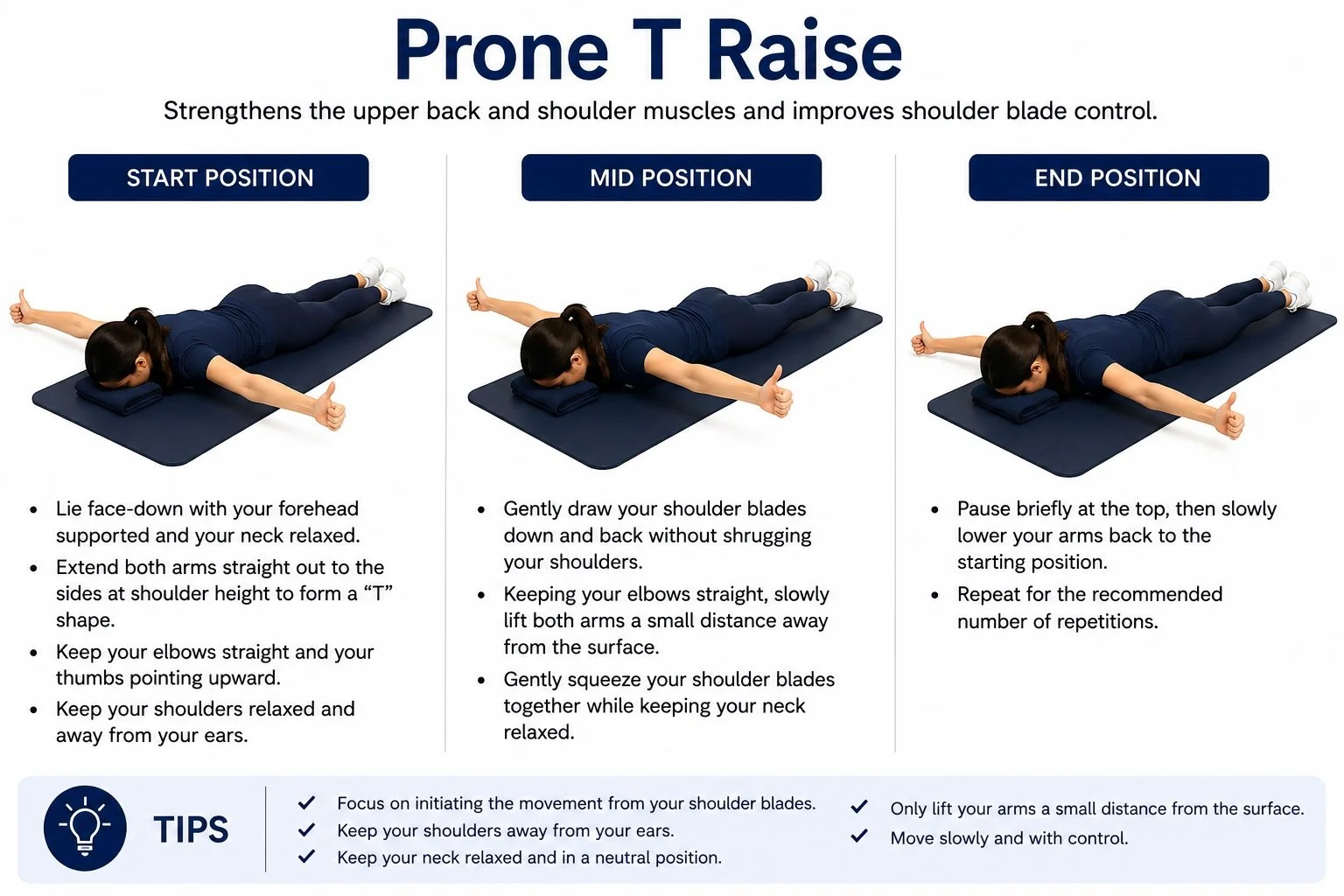
The Prone T Raise is a strengthening exercise that targets the muscles of the upper back and shoulder blades. Lying face-down allows gravity to provide gentle resistance while lifting the arms into a “T” position, supporting shoulder blade control, stability, and posture.
This exercise may support:
This exercise may help improve:
Shoulder blade stability
Upper back strength
Shoulder control
Postural strength
Weakness around the shoulder blades
Shoulder mechanics
Benefits
Strengthens the upper back and shoulder muscles
Supports shoulder blade stability and control
Supports controlled shoulder movement
Supports postural awareness and strength
Helps strengthen the muscles that retract the shoulder blades
Equipment Needed
Exercise mat, firm bed, or exercise table
Small towel for forehead support if needed
Starting Position
Lie face-down with your forehead supported and your neck relaxed.
Extend both arms straight out to the sides at shoulder height to form a “T” shape.
Keep your elbows straight and your thumbs pointing upward.
Keep your shoulders relaxed and away from your ears.
Step 1
Gently draw your shoulder blades down and back without shrugging your shoulders.
Step 2
Keeping your elbows straight, slowly lift both arms a small distance away from the surface.
Gently squeeze your shoulder blades together while keeping your neck relaxed.
Step 3
Pause briefly at the top, then slowly lower your arms back to the starting position.
Repeat for the recommended number of repetitions.
Recommended Repetitions
8–10 repetitions
1–2 sets
Perform once daily or as recommended by your healthcare provider
Tips
Focus on initiating the movement from your shoulder blades.
Keep your shoulders away from your ears.
Keep your neck relaxed and in a neutral position.
Only lift your arms a small distance from the surface.
Move slowly and with control.
Common Mistakes
Shrugging the shoulders toward the ears
Lifting the arms too high
Arching the lower back
Lifting or extending the neck
Bending the elbows
Using momentum instead of controlled movement
Stop the Exercise If
Stop and consult your healthcare provider if you experience:
Sharp or increasing shoulder pain
Numbness or tingling
Pain that worsens during or after the exercise
Unusual weakness or loss of shoulder control
Related Conditions
Shoulder Impingement
Rotator Cuff Injuries
Shoulder Instability
Poor Posture
Shoulder Blade Weakness
Related Services
This exercise may be included as part of an individualized home-care plan for concerns such as
Need More Help?
If shoulder pain, weakness, or limited movement is affecting your daily activities, an assessment can help identify factors that may be contributing to your symptoms and determine whether Massage Therapy, Osteopathy, or another healthcare approach may be appropriate.
Pelham Massage Therapy & Osteopathy Clinic Inc.
Disclaimer
This exercise is intended for general educational purposes only and should not replace professional medical advice, diagnosis, or treatment. Stop the exercise if you experience significant pain or worsening symptoms, and consult your healthcare provider if you are unsure whether this exercise is appropriate for you.