Tight Hip Flexors: Causes, Symptoms & How Massage Therapy May Help
Pelham Massage Therapy & Osteopathy Clinic | Fonthill, Pelham & Niagara Region
Do you sit for long periods at work, spend hours driving, or exercise regularly but still notice stiffness through your hips, lower back, or legs?
Tension in the muscles at the front of the hip can affect comfort and movement. At Pelham Massage Therapy & Osteopathy Clinic, our Registered Massage Therapists provide individualized Massage Therapy for clients experiencing hip, thigh, and lower-back tension.
What Are the Hip Flexors?
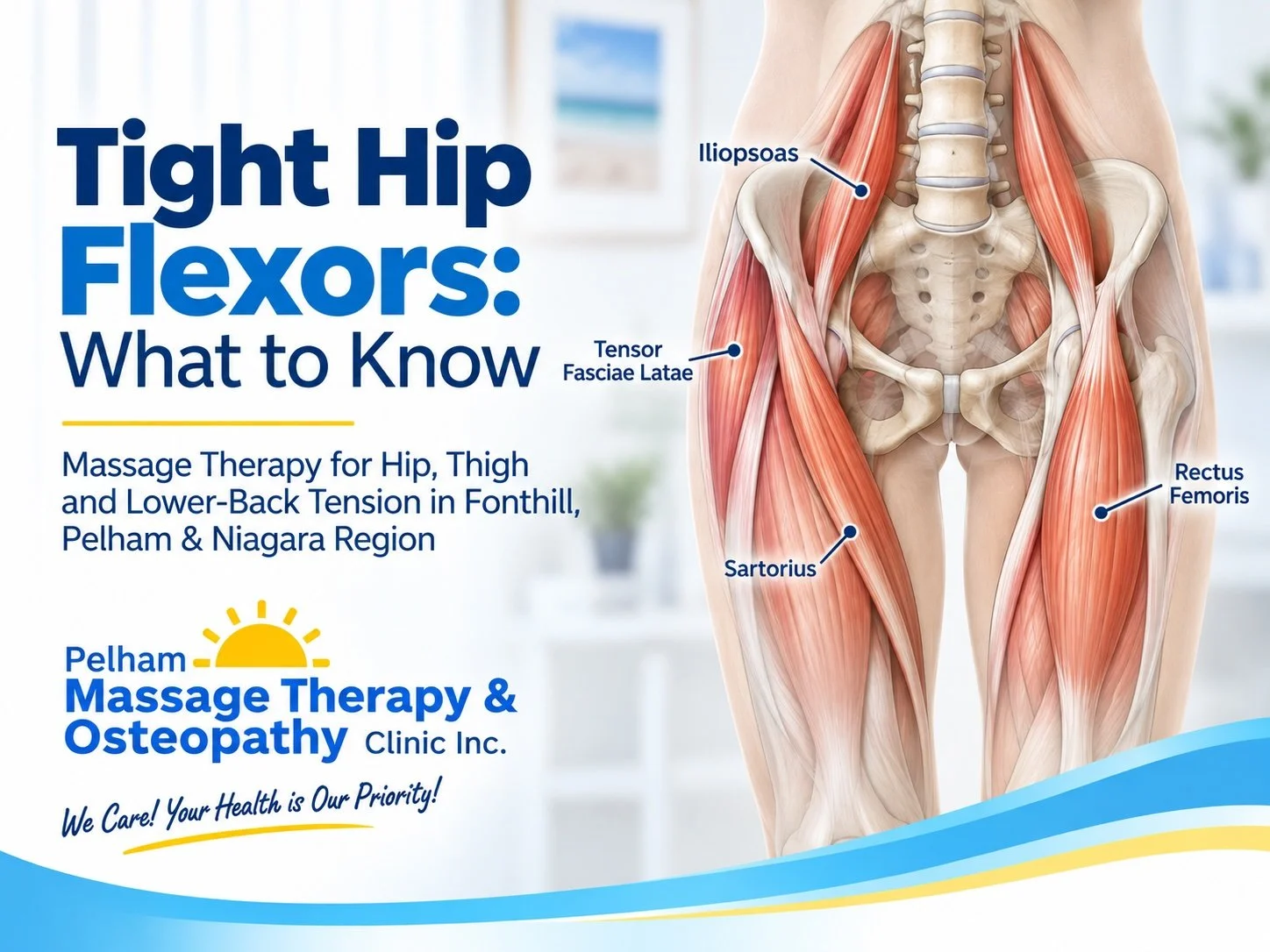
The hip flexors are a group of muscles located at the front of the hip that help lift the leg and bend the hip.
They include:
Iliopsoas
Rectus femoris
Sartorius
Tensor fasciae latae (TFL)
These muscles are active during everyday movements such as walking, climbing stairs, running, and getting up from a chair.
Why Can Hip Flexors Feel Tight?
Hip flexor tension may be associated with:
Prolonged sitting
Long periods of driving
Repetitive activity
Running or cycling
Changes in activity levels
Muscle tension
Previous injuries
Individual movement patterns
Spending long periods in one position may contribute to stiffness or a feeling of tightness through the front of the hips.
Signs of Hip Flexor Tension
You may notice:
Tightness in the front of the hips
Lower-back discomfort
Stiffness when standing after sitting
Reduced comfort with walking
Hip discomfort during activity
Difficulty with squatting or lunging
Tightness through the quadriceps
General stiffness around the hips and pelvis
Hip discomfort and lower-back tension can have many possible causes, so persistent or worsening symptoms should be assessed appropriately.
How May Massage Therapy Help?
Massage Therapy may be used to assess and treat relevant muscles and soft tissues around the hips, thighs, pelvis, and lower back.
Reduce Muscle Tension
Massage techniques may help reduce soft-tissue tension in the hip flexors and surrounding muscles.
Support Flexibility and Mobility
By addressing areas of muscular tension and stiffness, Massage Therapy may help support comfortable movement and flexibility.
Support Posture-Related Comfort
Prolonged sitting and repetitive activity may contribute to muscle tension around the hips and lower back.
Massage Therapy may help address soft-tissue tension associated with these positions and activities.
Support Comfortable Movement
An RMT may assess the hips and surrounding muscles to identify areas of tension or restriction that may be affecting movement.
Promote Relaxation
Massage Therapy may also be used to promote general relaxation and reduce physical tension.
Who May Seek Massage Therapy for Hip Flexor Tension?
Massage Therapy may be considered by:
Office workers
Drivers
Runners
Cyclists
Athletes
Active adults
People who experience lower-back or hip tension
Anyone who spends long periods sitting
General Self-Care Considerations
Depending on your individual needs, general strategies may include:
Taking regular movement breaks from sitting
Gentle stretching or mobility exercises
Gradually increasing physical activity
Adjusting workstation ergonomics
Staying active throughout the day
If symptoms are persistent, severe, or worsening, speak with an appropriate healthcare professional.
Massage Therapy for Tight Hip Flexors in Fonthill, Pelham & Niagara Region
At Pelham Massage Therapy & Osteopathy Clinic, our Registered Massage Therapists provide individualized care for clients experiencing hip, thigh, and lower-back tension or movement-related discomfort.
We proudly serve:
Fonthill
Pelham
Welland
St. Catharines
Thorold
Niagara Falls
Port Colborne
Niagara-on-the-Lake
Niagara Region
Book a Massage Therapy Appointment
If hip or lower-back tension is affecting your comfort or movement, an RMT can assess relevant muscles and soft tissues and determine whether Massage Therapy may be appropriate for your needs.
Related Services
Connect With Us
🌐 Website
📞 Call Us: 289-501-4229
We Care! Your Health Is Our Priority! 🌿
Marjorie Dickson, RMT