Tension Headaches, Muscle Tension & Massage Therapy
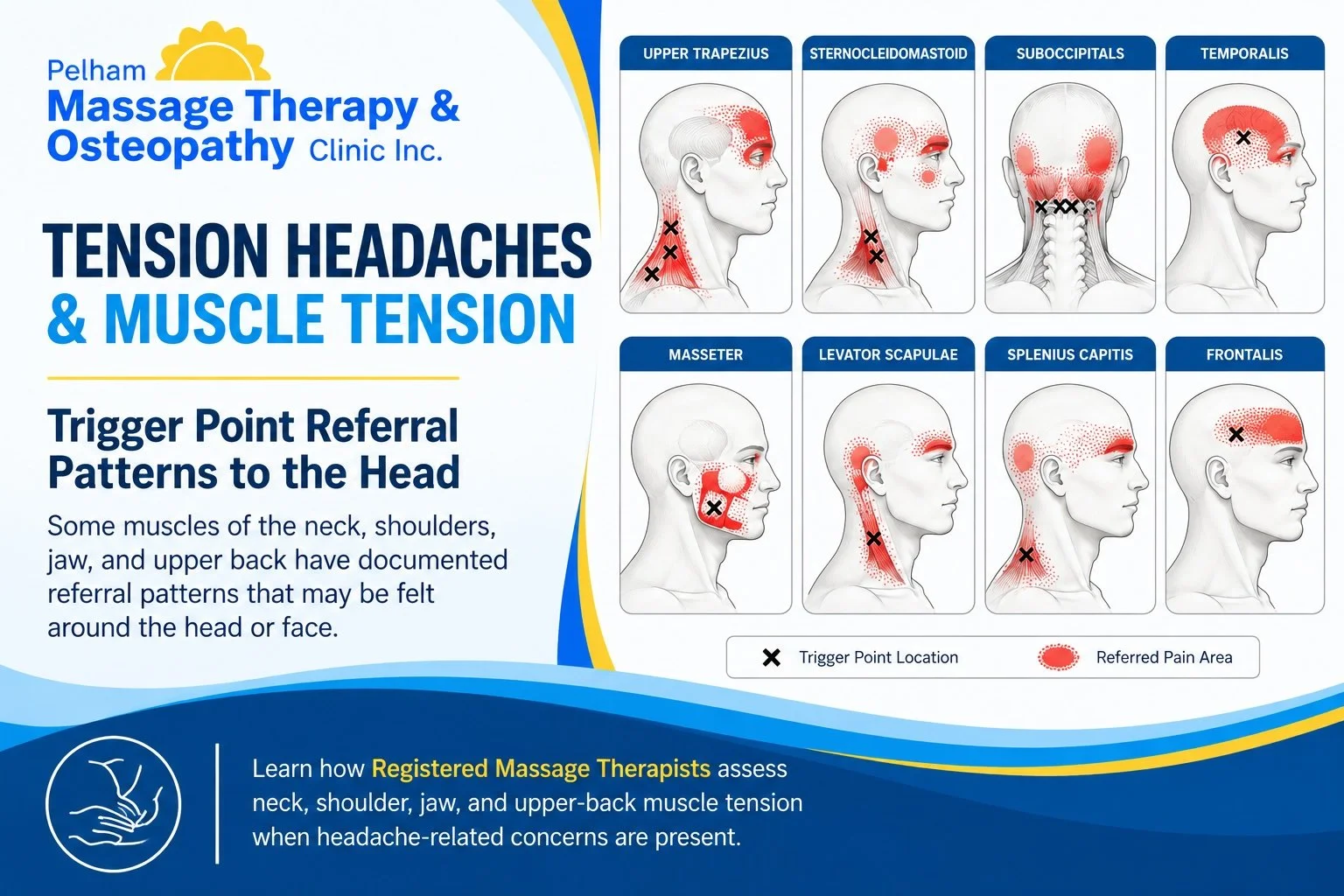
Are Tight Muscles Associated With Your Headache Symptoms?
Headaches can have many possible causes and contributing factors, including stress, sleep, hydration, vision concerns, medical conditions, and musculoskeletal factors.
Some people experiencing tension-type headaches also notice tightness, tenderness, or reduced mobility in the neck, shoulders, jaw, or upper back.
At Pelham Massage Therapy & Osteopathy Clinic in Fonthill, Registered Massage Therapists assess and treat muscles and soft tissues according to each client’s health history, assessment findings, and treatment goals.
What Are Trigger Points?
A trigger point is commonly described as a sensitive area within muscle tissue that may be associated with local tenderness or referred sensation in another area.
For example, certain muscles of the neck, shoulders, jaw, and upper back have documented referral patterns that can sometimes be felt around the head or face.
Factors that may be associated with muscular tension include:
Prolonged computer or desk work
Repetitive activity
Jaw clenching or grinding
Sustained positions
Physical activity
Previous musculoskeletal injuries
Stress-related muscle tension
Muscles Commonly Considered During Assessment
Upper Trapezius
The upper trapezius extends from the neck toward the shoulder.
An RMT may assess this muscle when a client reports neck or shoulder tension, tenderness, or symptoms associated with prolonged sitting or repetitive activity.
Sternocleidomastoid (SCM)
The sternocleidomastoid is located along the front and side of the neck.
Because it contributes to head and neck movement, it may be assessed when a client reports neck tension or changes in cervical mobility.
Suboccipital Muscles
The suboccipital muscles are a group of small muscles located at the base of the skull.
These muscles may be assessed when a client reports tension or tenderness around the upper neck or base of the skull.
Temporalis
The temporalis is one of the muscles involved in chewing.
It may be relevant when a client reports jaw clenching, grinding, facial tension, or tenderness around the temple region.
Masseter
The masseter is another major chewing muscle.
An RMT may assess this area when appropriate for clients experiencing jaw tension, clenching, or other musculoskeletal concerns involving the jaw.
Levator Scapulae
The levator scapulae connects the cervical spine with the shoulder blade.
It may be assessed when a client experiences neck or upper-shoulder stiffness, tenderness, or changes in movement.
How May Massage Therapy Be Used?
Massage Therapy involves assessment and hands-on treatment of muscles and soft tissues.
Depending on the individual assessment and treatment goals, an RMT may use techniques such as:
Trigger Point Techniques
Focused pressure or other manual techniques may be used when sensitive areas of muscle tissue are identified during assessment.
Myofascial Techniques
Hands-on techniques may be used to address soft-tissue mobility and areas of restriction.
Deeper-Pressure Techniques
Where appropriate and agreed upon with the client, an RMT may use deeper pressure when treating muscles of the neck, shoulders, upper back, or other relevant areas.
TMJ-Focused Massage Therapy
When jaw tension, clenching, or grinding is part of the client’s concern, treatment may include muscles involved in jaw movement.
Education and Self-Care
An RMT may discuss positioning, movement, stretching, or other self-care strategies when appropriate and within the therapist’s scope of practice.
When Might Someone Discuss Headaches With an RMT?
A client may mention headaches during a Massage Therapy assessment when they also experience concerns such as:
Neck or shoulder tension
Tender muscles
Jaw tension or clenching
Upper-back tightness
Changes in neck mobility
Symptoms associated with prolonged desk or computer work
Headaches can have many causes, so Massage Therapy should not be presented as a diagnosis or treatment for every type of headache.
When Should Headaches Be Medically Assessed?
Medical assessment may be appropriate for headaches that are:
Sudden and unusually severe
New or significantly different from previous headaches
Increasing in frequency or severity
Associated with significant trauma
Accompanied by weakness, numbness, confusion, fainting, fever, vision changes, or difficulty speaking
Massage Therapy in Fonthill, Pelham & Niagara Region
Pelham Massage Therapy & Osteopathy Clinic is located in Fonthill and provides Massage Therapy for clients from Pelham and surrounding Niagara communities, including Welland, Thorold, St. Catharines, Niagara Falls, Port Colborne, Fenwick, Smithville, and Niagara-on-the-Lake.
Related Services
Book Your Massage Therapy Appointment Today
🌐 Website
Call Us: 289-501-4229
We Care! Your Health Is Our Priority!
Marjorie Dickson, RMT