Massage Therapy & Osteopathy for Dental Professionals in Fonthill & Pelham
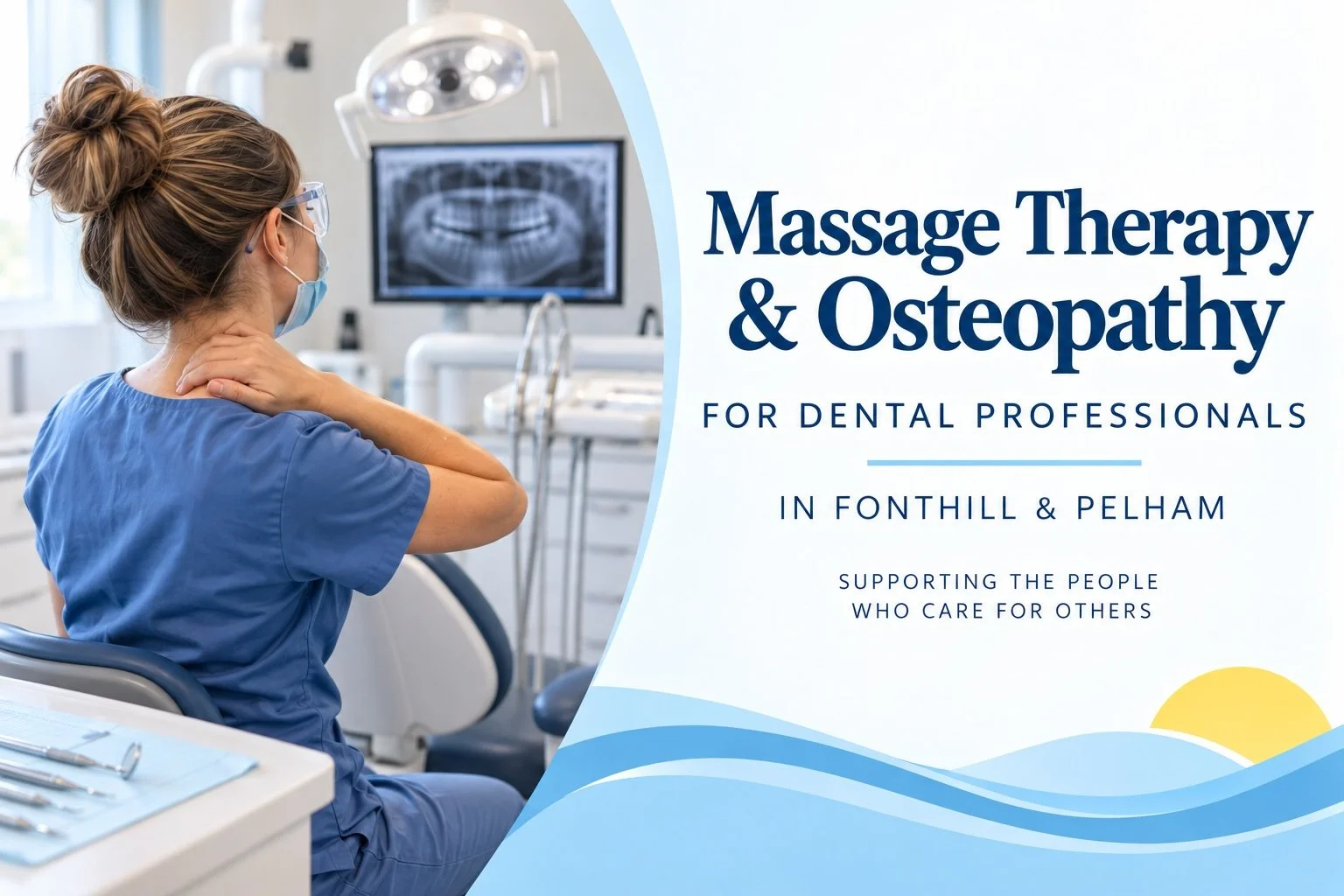
Dental professionals spend their days caring for others, but dentistry can also place significant physical demands on the body.
Dentists, dental hygienists, and dental assistants often work for extended periods in sustained positions while performing precise and repetitive movements. Over time, these demands may contribute to muscle tension, stiffness, fatigue, and discomfort — particularly through the neck, shoulders, upper and lower back, hands, wrists, and forearms.
At Pelham Massage Therapy & Osteopathy Clinic Inc. in Fonthill, Massage Therapy and Osteopathy are two separate services that may be considered by dental professionals looking to manage the physical demands of their work and support comfortable movement.
Why Can Dental Work Be Physically Demanding?
Dental professionals frequently need to lean forward, rotate or flex the neck, position their arms away from the body, or maintain the same position while concentrating on patient care.
Even relatively small movements can become physically demanding when repeated throughout a full workday.
Common physical demands may include:
Prolonged sitting or standing
Forward-head positioning
Reaching or leaning toward patients
Repetitive hand and wrist movements
Maintaining the arms in working positions for extended periods
Limited opportunities to change position between procedures
How these demands affect the body can vary depending on your role, working position, schedule, individual movement patterns, and other factors.
Neck & Upper Back Tension
The neck and upper back can be particularly affected by dental work.
Looking downward or leaning toward a patient for extended periods may contribute to muscle tension or discomfort through the neck, shoulders, and muscles surrounding the shoulder blades.
Massage Therapy may be used to address muscular tension and support comfortable movement.
Osteopathy involves an individualized assessment that may include the neck, upper back, ribs, shoulders, and other areas depending on your presentation.
Shoulder Discomfort
Dentists, hygienists, and assistants often work with their arms positioned away from their bodies.
Repetitive reaching and sustained arm positions may contribute to shoulder fatigue, muscular tension, or changes in comfortable movement.
Massage Therapy or Osteopathy may be considered depending on your individual concerns, assessment findings, and treatment goals.
Lower Back Discomfort
Long periods of sitting, standing, leaning, and rotating can also place demands on the lower back.
Changing positions throughout the day can be helpful, although this is not always easy when you are focused on patient care.
Massage Therapy may address muscular tension through areas such as the lower back, gluteal muscles, and hips.
Osteopathic care may include assessment of mobility and movement through the lower back, pelvis, hips, and other related areas.
Hands, Wrists & Forearms
Dental professionals rely heavily on their hands for precise and repetitive work.
Gripping instruments, performing fine motor tasks, and repeating similar hand movements throughout the day may contribute to fatigue or discomfort in the hands, wrists, and forearms.
Massage Therapy may be used to address muscular tension through the forearms and surrounding tissues based on your individual needs.
Persistent numbness, tingling, weakness, significant pain, or loss of function should be assessed by an appropriate healthcare professional.
How May Massage Therapy Support Dental Professionals?
Massage Therapy may help:
Reduce muscular tension
Support comfortable movement
Address muscular discomfort associated with repetitive activity
Support mobility and flexibility
Promote relaxation
Treatment can be individualized according to the areas most affected by your work, such as your neck and shoulders, back, forearms, or a combination of several areas.
How May Osteopathy Support Dental Professionals?
Osteopathic treatment takes a whole-body approach to assessment and care.
Rather than focusing only on the area where discomfort is felt, an osteopathic manual practitioner may assess movement and mobility in several areas of the body.
For dental professionals, this could include assessment of the neck, shoulders, upper and lower back, rib cage, hips, or other areas depending on the individual presentation.
Treatment is based on your health history, assessment findings, comfort level, and goals.
Small Changes During the Workday May Help Too
Manual therapy is only one part of caring for your body.
When possible, simple habits during the workday may also support comfortable movement:
Change positions regularly
Take brief movement breaks between patients when possible
Avoid remaining in one position longer than necessary
Keep frequently used equipment within a comfortable reach
Notice unnecessary shoulder or hand tension
Move and stretch periodically throughout the day
Small changes performed consistently may help reduce some of the physical strain associated with repetitive work.
Supporting Dental Professionals in Fonthill, Pelham & Niagara Region
Dental professionals spend much of their workday focused on the comfort and care of their patients.
If you're a dentist, dental hygienist, or dental assistant in Fonthill, Pelham, Welland, or the Niagara Region, Massage Therapy or Osteopathy may be options to consider when managing muscle tension, stiffness, or changes in comfortable movement.
At Pelham Massage Therapy & Osteopathy Clinic Inc., each service is provided separately and treatment is individualized according to your assessment, needs, and goals.
Related Services
Massage Therapy
Osteopathy
TMJ Massage
Connect With Us
🌐 Website
📞 Call Us: 289-501-4229
We Care – Your Health Is Our Priority.
Published by Pelham Massage Therapy & Osteopathy Clinic Inc.